506th FG Gazette
Mission notes, people, and progress—dispatches worth keeping.
LOCAL NEWS
LAKELAND, FL.
Carl Molesworth "Very Long Range P-51 Mustang Units of the Pacific War"
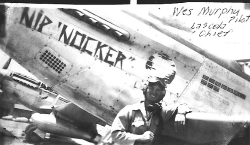
Lt. Wes Murphy 457th
Twenty-six-year-old 2nd Lt. Murphey was ferrying the P-47 Thunderbolt fighter plane on Jan. 5, 1944, from Wilmington's Bluethenthal Field to Fort Myers, Fla., when trouble started and a legend was born. Murphey took off about 5 p.m. that Wednesday evening. He was in the air for only 10 minutes, but he was already 25 miles southwest of Wilmington and over the Green Swamp, a 140-square mile longleaf pine savanna with a patchwork of swampland. Although Murphey's ultimate destination was Fort Myers, he planned to spend the night in Charleston, S.C. From the very beginning, his flight was troubled.
"The right landing gear would not stay in up position so I dropped the wheels several times to try to remedy this trouble," he wrote in an official accident report. A fellow pilot reported that a broken hinge on the gate of the right landing gear cover was the culprit.
While Murphey was trying to correct the landing gear problem, the P-47 climbed to only 2,000 feet.
Second Lt. Virgil D. Newby was Murphey's wing man on the hop to Charleston and an eyewitness to the trouble brewing in the skies.
"When we were approximately 25 miles from the Bluethenthal Field, the underneath of the plane was covered with flames," Newby wrote. "The fire went out and black smoke started coming from underneath the engine cowling."
Newby said Murphey made a 180-degree turn and was headed back to Wilmington.
That's when the situation became more dire. The P-47's automatic propeller control – used to control the pitch of the propeller – went out. Murphey controlled the propeller manually before the Thunderbolt gradually lost power, dropping to 500 feet and forcing him to attempt a landing.
"I landed in a marsh which was straight ahead," he wrote. "The ship skidded to a stop, turning about 30 degrees, and stopped in a normal position."
It was about 5:30 p.m., with winter's darkness closing in. Murphey hunkered down in the P-47's cockpit for the night, alone and with the vastness of the swamp stretching in every direction. While temperatures had climbed into the mid-50s during the day, they dropped into the mid-30s overnight.
A rescue party reached the Thunderbolt and Murphey about mid-afternoon the next day, Jan. 6. Murphey later told relatives it took them most of the day to walk out of the swamp. And with that walk, Murphey's name was lost to history – until Ferris came along on his quest for information about P-47B 41-5920.
WORLD NEWS Jan 1944
- 3: Major Gregory Pappy Boyington, the USMC fighter ace, was shot down after downing the last 3 of his 26 victories, and would spend the next 20 months in Japanese POW Camps.
- 4: The 1st Ukrainian Front of the Red Army enters Poland.
- 9: British forces take Maungdaw, Burma, a critical port for Allied supplies.
- 11: Count Ciano, the Italian Foreign Minister and Mussolini's son-in-law, is executed by Mussolini's revived Fascist government sympathizers.
- 12: The SS United Victory, the first Victory ship, is launched; this class of transport will prove to be crucial in hauling men and supplies across the oceans.[1]
- 16: General Dwight D. Eisenhower arrived in London, returning from a week of rest and planning in Washington, D. C., and assumed command of the European Theater by General Orders No. 4. His new title was Commanding General, U.S. Forces, European Theater of Operations.
- 17: The first Battle of Monte Cassino begins when the British X Corps attacks along the Garigliano river at the western end of the German Gustav Line.[2][3][4]
- 19: Red Army troops push westward toward the Baltic countries.
: British Operation Outward accidentally claims lives in Sweden by knocking out lighting and causing a train crash.
- 20: The Royal Air Force drops 2,300 tons of bombs on Berlin.
: The U.S. Army 36th Infantry Division, in Italy, attempts to cross the Gari River but suffers heavy losses.
- 22: Allies begin Operation Shingle, the landing at Anzio, Italy, commanded by American Major General John P. Lucas.[2][3][5] The Allies hope to break the stalemate in south Italy, but they are unable to break out of the beachhead and the line holds until late May. The minesweeper USS Portent (AM-106), commanded by Lt. H.C. Plummer, hit a mine and sank southeast of Anzio, Italy.
- 24: The Allied forces have a major setback on the Gari River in Italy.
- 24: In German-occupied Belgium, the Social Pact, detailing plans for post-war social reform, is secretly signed.
- 27: The Siege of Leningrad ended after 872 days, as Soviet forces finally forced the Germans to withdraw. Some 2 million died, mostly of starvation and disease.
- 28: The Soviet Army completes encirclement of two German Army corps at the Korsun pocket, south of Kiev. Two-thirds of the Germans escape in the breakout next month with the loss of most heavy equipment.
- 30: The Japanese kill 44 suspected spies in the Homfreyganj massacre.
: At Anzio, Italy the disastrous Battle of Cisterna took place, as MG John P. Lucas sent Darby's Rangers to begin the breakout from the beachhead. One of the four battalions in the action returned with only 6 of 767 men, the rest killed, wounded or captured.
July 1945

Issue 1 Saturday, Oct 21, 1944
Issue 2 Wednesday, Nov 01, 1944
Issue 3 Wednesday, Nov 01, 1944
Issue 16 Jul 04 1945 Part I