506th FG Gazette
Mission notes, people, and progress—dispatches worth keeping.
LOCAL NEWS
IWO JIMA
Carl Molesworth "Very Long Range P-51 Mustang Units of the Pacific War"
04 July 45 Part II
Mission: Number 27 (FC Mission #217) 4 July 45
Force: VLR Fighter Strike against Japanese airfields in the northeast and east areas of Tokyo by 159 Mustangs, with one squadron of fifteen planes escorting two Navy B-24 photographic planes over the Yokosuka Naval Base.
Results: Nine enemy aircraft destroyed, three probably destroyed and twenty-two damaged. Miscellaneous ground installations in the Tokyo area, and shipping, mainly on Kasumiga Lake and in the Tone River, were destroyed or severely damaged.
Claims against the enemy: 1 probably destroyed and 2 damaged in air; 7 destroyed and 15 damaged on the ground
Our losses: One P-51 shot down over Kasumigaura with pilot missing. Nine aircraft were damaged, seven by enemy flak, and two as the result of a Japanese plane exploding on the ground. None of the pilots was injured.
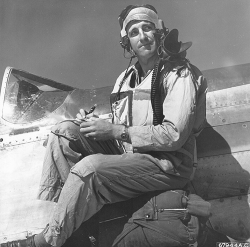
The 457th Fighter Squadron had the strafing assignment at the primary target. After which navigational difficulty due to weather, the squadron became separated. Blue and Green flights strafed the PT at 1315 from NW to SE. Blue flight covered the SE side of the field and Green flight the NE. 10 A/C damaged on the ground are claimed as a result of the run. Continuing beyond the target a loaded truck was fired by Lt. Max E. Ruble who also strafed a 50-60 foot fishing boat as he went back over the water.
The 458th Fighter Squadron had the strafing assignment at the primary target. After which navigational difficulty due to weather, the squadron became separated. Blue and Green flights strafed the PT at 1315 from NW to SE. Blue flight covered the SE side of the field and Green flight the NE. 10 A/C damaged on the ground are claimed as a result of the run. Continuing beyond the target a loaded truck was fired by Lt. Max E. Ruble who also strafed a 50-60 foot fishing boat as he went back over the water. Red and Yellow flights were unable to locate the PT in the weather but upon letting down through the overcast saw what appeared to be commercial airport in the neighborhood of the west arm Kasumiga Ura. The field had a sodded landing area, 4 or 5 hangars and had several dummy A/C parked along the west edge. The A/F installations were strafed but believed only minor damage was inflicted. Only 1 or 2 non combat type planes were seen on the field.
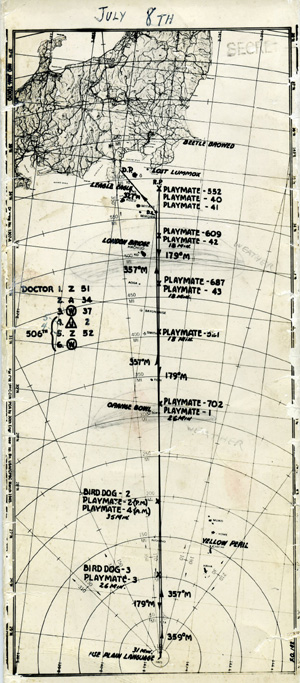
The planned attack could not be carried out due to weather and the fighter strike resolved itself into a haphazard and generally ineffective mission.
B-29s were usually at the 22000’ with escorting fighters flying mutual support stepped up at about 25000’. The difference in the LS permitted broad weaving tactics. Although there was 9/10 cloud coverage, a hole was located over Yokosuka permitting photographs of the area desired. After breaking for the Rally Point 4 S/E enemy fighters were sighted 5000’ above and at an estimated 10 mile range over Kiserazu A/F on a NE course. A flight was dispatched to meet the bandits but as no interception was attempted pursuit was broken off as the range was opening. There was no indication the enemy had spotted our formation. Rally was made with other Squadrons returning enemy fighters were sighted 5000’ above and at an estimated 10 mile range over Kiserazu A/F on a NE course. A flight was dispatched to meet the bandits but as no interception was attempted pursuit was broken off as the range was opening. There was no indication the enemy had spotted our formation. Rally was made with other Squadrons returning from the strike mission for return to Base. The 457th Fighter Squadron was ordered to provide top cover for the 458th as it strafed TSUKUBA A/F from the deck. The 457th orbited this target area above 9/10 cloud cover until a hole was located when Green flight with 3 rocket ships was sent down to "flak bust* for the deck Squadron. The target was strafed in the air and rockets were released 4500’ at 460mph IAS all with unobserved results due to cloud cover. Weather conditions made it impossible to provide more than area support. After the deck squadron had gone across the target, the area to the northwest patrolled by the 457th in the hope of stirring up some enemy activity but without success.
WORLD NEWS July 1945
- 1: Australian troops land at Balikpapan, Borneo in the Western Allies' last major land operation of the war.
- 5: General Douglas MacArthur announces that the Philippines have been liberated.
- 6: Norway declares war on Japan.
- 14: Italy declares war on Japan.
- 16: The U.S. conducts the Trinity test at Alamogordo, New Mexico, the first test of a nuclear weapon.
- 17: The Potsdam Conference begins under British Prime Minister Churchill, Soviet Prime Minister Stalin and U.S. President Truman. The Allied leaders agree to insist upon the unconditional surrender of Japan.
- 22: America and Japan engage in a small skirmish in the Battle of Tokyo Bay. The Japanese take slight losses
- 26: The Labour Party win the British general election by a landslide. Clement Attlee replaces Churchill as British Prime Minister and immediately flies to the negotiating table at Potsdam. The Potsdam Declaration is issued.
- 28: The Japanese battleships Haruna and Ise are sunk by aircraft from US Task Force 38 while in shallow anchorage at Kure Naval Base.
- 30: The USS Indianapolis is sunk shortly after midnight by a Japanese submarine after having delivered atomic bomb material to Tinian. Because of poor communications, the ship's whereabouts are unknown for some time and many of its men drown or are attacked by sharks in the next four days.
- 31: U.S. conducts air attacks on the cities of Kobe and Nagoya in Japan.
July 1945

Issue 1 Saturday, Oct 21, 1944
Issue 2 Wednesday, Nov 01, 1944
Issue 3 Wednesday, Nov 01, 1944
Issue 16 Jul 04 1945 Part I